B2B Personas
I led a self-initiated revamp of B2B personas, auditing existing insights, conducting competitive research, defining an Ideal Customer Profile, and aligning persona-based messaging across the funnel to bring strategic clarity to marketing and product teams.
25%
Faster Content Approval
Less
Review Cycles
01
Key Area
Target Users
Marketing, Sales, Design, Engineers
Timeline
5 months
Category
B2B SaaS
Type of Work
User Research
Interviews
Buyers Journey
3 Points Analysis
When I joined a cloud platform startup, the team lacked a structured understanding of their B2B audiences, relying on vague labels like “User” and “Buyer.” I built an evidence-based persona system from the ground up by auditing internal knowledge, conducting external research to define the ICP, clustering personas using a strategic framework, and validating with stakeholders — aligning product and marketing around real decision-makers and enabling more targeted messaging.

-
Design: Figjam
-
Research/Validation: user interviews, UAT pilots
-
Collaboration: Slack, Internal sheets
Process
1. Auditing Existing Knowledge
I started by auditing everything the team had been using to represent “personas”: Slack threads, Notion docs, Ad briefs and internal decks
What I found?
-
Vague categorizations
-
No buying motivations or behavior insights
-
No mapping to the buyer journey
The knowledge was shallow, fragmented, and not actionable for marketing or product decisions.

The knowledge was shallow, fragmented, and not actionable for marketing or product decisions.
2. Competitor's Analysis
With no internal data to rely on, I pivoted to external intelligence:
-
Studied competitor client lists
-
Reviewed public case studies, testimonials, and industry blogs
From this, I built an Ideal Customer Profile (ICP) that included:
-
Industry verticals
-
Team structures
-
Cloud maturity levels
-
Key pain points
I then created 10+ initial persona candidates operating within that ICP, including: Platform engineers, DevOps leads, CTOs, compliance officers, finance gatekeepers, etc.
Gartner reports that the average B2B buying group now includes 6 to 10 decision-makers, each with different roles, priorities, and pain points.
-
Primary personas (e.g., Platform Engineers, DevOps) are the users and champions.
-
Secondary personas (e.g., CTO, VP of Engineering) may approve or heavily influence, but aren’t hands-on.
-
Tertiary personas (e.g., Compliance, Procurement) can block a deal, but don’t seek or use the product.
Why Use Persona Levels (Primary / Secondary / Tertiary)?
-
Because they have different buying triggers, goals, and outcomes
-
Because Not All Personas Deserve Equal Investment
-
Because Buyer Journeys Are Nonlinear
By defining both the ICP and buyer personas, we can effectively target the right organizations and engage the key stakeholders within them, enhancing the efficiency and effectiveness of its go-to-market strategies.

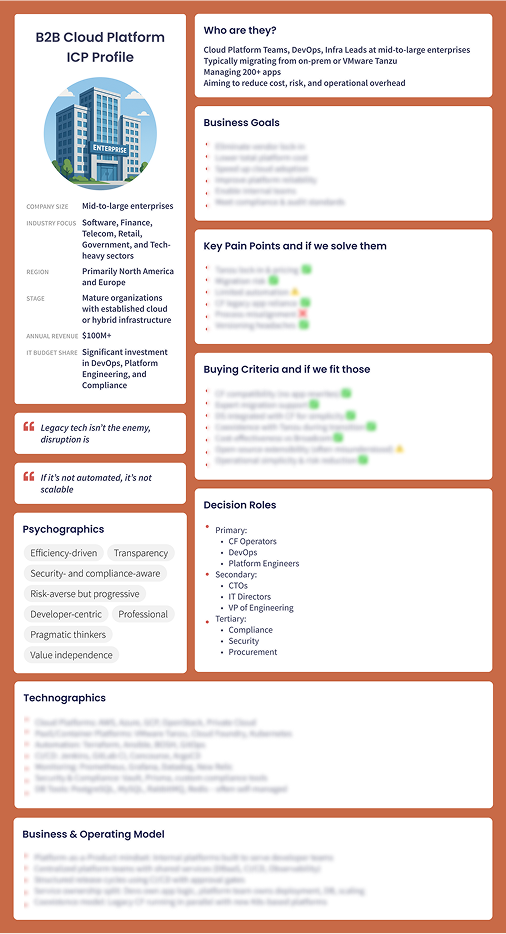
While ICP defines the right companies; personas define the humans inside them.
3. 3-Point Analysis
To avoid duplicate personas, I created a clustering method based on 3 critical questions:
Q1. What triggers their buying decision?
Q2. What outcomes or features do they care about?
Q3. How do they influence the purchase?
If personas shared at least 2 of 3 answers, they were grouped together.
This resulted in three strategic groups.

-
Primary: Initiators and strategic influencers (e.g., Platform Engineers, CTOs)
-
Secondary: Indirect influencers (e.g., SREs, DBAs)
-
Tertiary: Gatekeepers (e.g., Finance, Compliance, Security)
4. Internal Validation
To test and refine the clusters, I created a structured questionnaire for customer-facing teams:
-
Sales
-
Pre-sales engineers
-
Product marketing
The survey avoided jargon and focused on uncovering:
-
Real concerns from prospects
-
Objections heard during sales
-
Language customers used to describe pain points


Results:
-
Confirmed key hypotheses
-
Invalidated outdated beliefs
-
Uncovered new messaging opportunities
Outcome & Impact
Structured Persona Framework
Replaced ad-hoc labels with a defined, multi-level persona system aligned to real user and buyer behaviors.
Evidence-Based Targeting
Campaign briefs now target specific personas and pain points, enabling more relevant messaging and better engagement.
Clear ICP Foundation
Introduced a robust Ideal Customer Profile that guided audience prioritization and segmentation strategies.
Faster Decision Making
Clear differentiation between product types and quantity breakdowns improved user confidence in meeting regulatory requirements.
Shared Understanding Across Teams
Marketing, sales, and product teams now speak the same persona language, reducing miscommunication and accelerating campaign planning.
Ongoing Alignment Process
Set up a repeatable persona validation and refinement process, reducing ambiguity for future launches and product evolution.